Forum Replies Created
- AuthorPosts
As tension between Rwanda and Burundi simmer, the United Nations Special Adviser on the Prevention of Genocide, Adama Dieng, has expressed his concern at inflammatory statements by public officials in Bujumbura that could constitute incitement to violence including, most recently, by a senior official of the ruling CNDD-FDD political party.
In a statement on 16 August 2016 that was published on the CNDD-FDD website, Pascal Nyabenda, who was at the time President of the CNDD-FDD party and President of the National Assembly, suggested that the genocide in Rwanda was a fabrication of the international community, (“montages genocidaires contre le Gouvernement dit Hutu de Kigali”) that was used to remove the Hutu government that was in place at the time.
“This irresponsible statement could be interpreted as genocide denial”, Mr. Dieng warned, “and has the potential to inflame ethnic tensions, both within Burundi and outside its borders”.
Burundi continues to grapple with a deadly internal conflict that has left hundreds dead and many more displaced to refugee camps in neighboring countries.
Rwanda believes Burundi government continues to target ethnic Tusti army officers and civilians in the great purge aimed at consolidating President Pierre Nkurunziza’s hold onto power.
At the 20 August meeting of the party, a new head of the CNDD-FDD was appointed but Mr Nyabenda continues in his role as President of the National Assembly.
United Nations said the situation in Burundi continues to be marred by instability and reports of serious human rights violations, including allegations of extra-judicial killings, disappearances, torture, and arbitrary detention of members of the opposition, civil society and those suspected of opposing the Government.
Human rights defenders and journalists are among the hundreds of thousands of people who have fled the country since April 2015.
In its concluding observations, issued on 11 August 2016 following a special report submitted at the request of the United Nations Committee Against Torture (CAT), the Committee’s international experts expressed deep concern over the hundreds of reports of torture received and called for investigations into all cases of killings, enforced disappearances and other violence motivated by the ethnic origin of the victim.
The Committee urged the Burundian Government to “refrain from making any public statements that could exacerbate ethnic tensions or incite violence or hatred and to ensure that public and law enforcement officials do not accept or tolerate such acts by other groups.”
Special Adviser Dieng also raised concern that the youth wing of the CNDD-FDD party, known as the Imbonerakure, continues to be associated with human rights abuses and is reported to have threatened ethnic violence.
He noted that the Minister of the Interior of Burundi had confirmed that the Imbonerakure formed part of the national security strategy, as the CAT also pointed out in its concluding observations.
Special Adviser Dieng reminded the Government of Burundi of “its obligation to protect its populations, regardless of their ethnicity or political affiliation, and to refrain from any action or discourse that could inflame ethnic tensions.”
He highlighted the importance of countering such messages with alternative speech to foster unity rather than further entrench divisions, and called on all parties to prioritize inclusive dialogue to bring about an end to the protracted crisis.
DRC President Joseph Kabila this Friday traveled to the Rwandan border town of Rubavu where he met with his Rwandan counterpart, Paul Kagame.
The meeting was largely a surprise to many considering that relations between DRC on one hand and Uganda and Rwanda on the other have been frail.
The M23 conflict in Eastern Congo that saw DRC mobilise military support from South Africa, Tanzania and Malawi to fight instead of dialoguing with the rebel force unsettled Museveni and Kagame.
The war affected regional tourism as Uganda and Rwanda have several tourist attraction sites at their borders with Congo.
The situation nearly went out hand with artillery shells of the anti-M23 force hitting Rubavu in Rwanda and Kisoro in Uganda.
Both Museveni and Kagame ordered deployments of artillery equipment in the affected areas, bringing the three countries to the edge of an all-out war.
The defeated M23 rebels fled to Uganda and Rwanda. While some of the former fugitives have returned home, many have refused to leave in fear of their lives.
Before meeting President Kagame, Kabila held talks with Museveni at Mweya Safari Lodge in Kasese. This was the first time since 2012 that Kabila was returning to Uganda. He was last in Uganda at the peak of the M23 conflict.
Kabila’s gesture has revived hopes that the three countries can do more together for the good of their people after years of animosity, hatred, suspicion and counter espionage missions.
Kabila’s father, Laurent Kabila was installed with the support of Museveni and Kagame following a disastrous war that left thousands dead.
Laurent would later fall out with Rwanda before the exit of then DRC Forces’ Chief of Staff, Gen James Kabarebe.
Despite conducting joint military missions to eradicate the genocidal FDLR group in Eastern Congo, Kigali still believed that Kinshasa was not doing enough.
UN investigations also showed collaboration between Congolese generals and FDLR elements in Kivu.
But the talks between Kabila and Kagame have breathed new life into both countries relations.
In Rwanda, Kagame and Kabila were accompanied by delegations that included Alexis Tambwe Mwamba, DRC Minister of Justice, Atama Tabe, DRC Minister of Defence and Martin Kabwelulu, DRC Minister of Mines and Louise Mushikiwabo, Rwandan Minister of Foreign Affairs and Cooperation, James Musoni, Rwandan Minister of Infrastructure and Germaine Kamayirese, Rwandan Minister of State in charge of Energy at the Ministry of Infrastructure.
Energy
“The two sides exchanged on several topics regarding mutual interest and agreed to strengthen bilateral cooperation, particularly in the areas of cross-border trade and energy, specifically in the extraction of methane gas in Lake Kivu,” reads the joint statement signed by DRC and Rwandan officials.
“It was agreed that the Joint Technical Team will begin its work before the end of August 2016.”
Dissolved within Kivu, which straddles the border of the two countries are about 60 billion cubic meters of methane and 300 billion cubic meters of carbon dioxide.
Warm ties between the two countries would see construction of bigger plants to exploit methane hence expanding household access to power and reduction of environmental hazards.
The first phase of this project in Rwanda is powering three gensets to produce 26 MW of electricity for the local grid. The next phase of this project will deploy nine additional gensets at 75 MW to create a total capacity of over 100 MW for Rwanda.
Uganda government spokesperson, Ofwono Opondo, said in an article this week that, “The DRC which enjoys an observer status seems to have realized that it is being left behind by the progress of the East African Community (EAC) and now wants to join some of the infrastructural investment projects.”
Indeed, at the recent Northern Corridor Ministers’ meeting, DRC representatives expressed their intention to join the infrastructural frameworks.
They further stated that Kabila was in touch with Museveni to ensure their inclusion into the arrangement aimed at resolving infrastructural bottlenecks hindering cross border trade, foreign direct investments, movement of goods and genera; economic growth.
Accordingly, DRC agreed to join the Uganda-Tanzanian oil pipeline, and Uganda to connect a 220kv electricity power line to its east.
Also, a joint technical team on petroleum exploration and production between Uganda and DRC is to be set up within this month.
Security
Regarding cooperation in the area of security, both DRC and Uganda hailed the progress made in line with eradicating negative forces, and also stressed the importance of establishing a strong mechanism for the timely sharing of intelligence.
Officials told us that this would help in swift neutralisation of common security threats along the border.
The two sides also committed to “mutual efforts for the revitalization of bilateral relations, including the enhancing of diplomatic relations between Rwanda and the Democratic Republic of Congo.”
Opondo said the re-demarcation of the border where disputes have been from Arua in the north down to Kasese district was reported to be progressing well.
Nevertheless, it will be recalled that Kabila’s third term bid is facing stiff resistance in his country, with the opposition and Catholic Church calling for his exit.
Bloody riots have previously rocked Kinshasa and other cities with the youth protesting against plans to amend the Constitution to allow Kabila’s stay in power.
Only time will tell if Kabila is wooing Kagame and Museveni in his quest to retain his hold onto power in the politically fragile country recovering from decades of a destructive conflict.
Opondo argued that Africa’s socio-economic transformation demands that there must be stability, democracy and good governance, and “so it so refreshing that its leaders are somehow now beginning to listen to each other, compromising and finding common purpose as was seen in Rwanda during the just concluded AU Summit.”
Opposition strongman Dr Kizza Besigye has ruled out the possibility of using arms to remove the government of president Museveni, saying a violent change of the statusquo does not necessarily lead to empowerment of citizens to determine their own destiny.
Besigye, who is on court bail after spending two months at Luzira prison on charges of treason, said, “Violence doesn’t cause the type of change that we want. The change we want is not just a change of government.”
“We want a change that will empower all our citizens,” said the former FDC presidential candidate while appearing on NBS Television on Wednesday morning.
Dr Besigye has for long been accused of quietly plotting to overthrow Museveni with the use of force or by dividing the armed forces, charges he denies.
However, the politician, who participated in the NRA guerrilla war that brought Museveni to power in 1986, says he has the potential to use guns to achieve his goals.
All the FDC stalwart lacks, he says, is the willingness to pursue the path of war.
“Museveni used violence which left half a million people dead; left hospitals, schools and commercial infrastructure destroyed. That is the option we don’t want to take,” said Besigye.
“Rebellion doesn’t deliver the results we want. We won the war but did not make people take charge of their country,” he assured.
Besigye also vowed not to abandon his defiance campaign.
“Defiance is my favoured course of action,” said Besigye, adding he would continue to mobilise people using a strategy that comprises three components – awareness, oganisaation and action.
“Because of our activism, that is why we say we have evidence we did not lose the election as Kiggundu (Electoral Commission boss) wanted the country to believe. We have evidence of that,” emphasised the FDC honcho.
P10
Regarding allegations that FDC intended to use P10 grassroots structure to instigate countrywide violence, Besigye said people have the right to organise themselves to achieve a common goal.
“It is our right. The regime was trying to say that P10 is recruitment for a rebellion. Nonsense. Ugandans have a right to organize themselves. That’s one of their fundamental rights.”
On his way forward in the wake of treason charges, Besigye said, “Politics is one of the most unpredictable things.”
He pointed to the possibility of the government’s collapse.
“Even as we are talking here, the regime can collapse. Every ingredient is there for the regime to collapse any time. But it can also hang on depending on what our actions are,” he observed.
“It can collapse on its own. The regime collapsing and people assuming power are two different things. This regime is so vulnerable, it can collapse any time. But that won’t give people power. People must be mentally alert; regain power and influence in their country; and leaders must act as servants not masters of the people.”
With the surrender of Mugisha Muntu to the Kizza Besigye crusade, it is fair to wonder what the Forum for Democratic (FDC) still stands for especially against the backdrop of the “Policy Agenda for Uganda’s Leap Forward,” that Muntu launched in March, 2015. Since Besigye left his freewheeling days as NPC travelling on the public wagon, he has become a permanent fixture in Uganda’s opposition politics, and a committed rebel.
In that role, Besigye has unsuccessfully been trying to sow fear and despair rather than hard work and hope among the unsuspecting public in the futile hope he could get elected as president of Uganda.
Besigye continues to say that we should build institutions, political parties inclusive in which there is regular change of leadership. But, what does that say of a man who espouses the need to create change in leadership, then doesn’t want to leave the stage or perhaps bidding time for his wife to replace him! Besigye and the rise of anarchy could be the price we are paying for living in a democracy.
FDC has always claimed the moral high ground of Uganda’s recent politics although that should be laughable, now that it is a refuge for sowing hate. With Besigye, FDC is running towards a wall or indeed the wall is getting nearer to it now. If FDC refuses to update its democratic credentials it could reach its end sooner. Innovation, is a cliché across every trade, yet FDC seems to believe that Besigye can continue using his four failed attempts as if Uganda hasn’t changed.
Even after Museveni has rebuilt the state, and started getting positive returns, Besigye gets misty-eyed about achievements pretending to be the one deeply caring about the poor, the vulnerable and underdogs. He claims that NRM is rotten.
It is Besigye who has fretted about internal change, giving room and social justice, portraying Museveni as seeking life leadership with privileges, and heartless to the point of sadism. But, when a party’s presidential candidate clings to power than perhaps necessary, it’s more than a bad look, it’s a sign that something has gone fundamentally wrong.
If NRM looks like it’s having a tough time, FDC’s troubles is even more tectonic because, it is not one party, rather, it is at least two irreconcilable factions running confused. The NRM is already burying its divisions over elections to ensure stable and effective government, with eyes firmly on the next general election. FDC is in a free fall with arguments over the legality of elections past while Muntu supposedly its real elected leader has been swatted away like a fly.
We now know that Besigye has clipped Muntu’s wings as he seeks to ensure there is no challenge in 2021, with prospects he will be returned to the leadership, with a free hand to de-select those ‘rebels’ who may want to cause him headache. All of this FDC infighting has to be seen against Uganda’s enormous progress, and certainly arguing among themselves and present no coherent alternative to NRM.
There is little prospect of FDC shaping the debate around Uganda’s economic and political future or impact in the region or continent, and in so doing, FDC is failing those who oppose NRM. For Besigye, the purity of opposition beats the necessary compromises and reality of government because after all, why stand for something when you can simply be against it. Besigye doesn’t present an alternative and if he continues in leadership, the opposition will lose its ideal brand name and many may conclude that the patient is ready for the mortuary.
For his inner-circle, the priority is not policies but spreading paranoia, not challenging the government but to frame whoever disagrees with their febrile line as conspiracy wreckers inside their party.
During footages of Besigye’s walkabouts, he wants to appear ‘a man of the people’, although he comes across more a schoolboy who suddenly discovers an interest in tidying his room rather than doing his homework. The trouble is, this teenager is supposed to be leading a responsible opposition.
He is probably supposed to be holding NRM government to account over the economy, education, health services, housing, tax avoidance, and possibly even electoral fraud. He is supposed to be making a convincing case to voters for a calm environment as tool to attract especially foreign investments in order to create jobs, but he has dismally failed.
Besigye might be belligerent, but since when has a role model for good leadership been so angry even for no apparent reason, which may as well be his next campaign slogan. One reason for Besigye to seek civility should be to protect the vulnerable against the volatility in investment climate. His anarchy is a scam and thuggish, and the victims will be the poor, who he claims to represent. Most Ugandans support stability, unfortunately Besigye doesn’t see his line as futile.
I suggest to Besigye that what voters really want, more than anything is clear, coherent policies on issues that really matter and the veneer of competence and civility. That would be a new kind of politics, although the black shark is still out
I have lately developed ‘required’ sense of ‘wisdom’ of keeping my opinion to myself unless it’s an issue to do with land and land reform policy.
I have successfully kept my opinion on issue of “reverse parking” now threatening to tear Green Hill Academy to pieces. Until today, I thought I would do the same on Police and Police brutality, a topic increasingly becoming boring yet un-ignorable.
As we interface with policemen (and policewomen; just to be politically correct) in our everyday activities, we certainly developed a confused sense of emotions towards them.
We go to sleep hating them because news put them on the bad side of the story, but by 10am the following day, we love them because we found them regulating traffics and helping school children cross roads.
But how do we save ourselves from our self-afflicted confused sagacity of emotions towards our police?
There is only one way; divide police into two. The People’s Police Force; PPF (sounds like tables but it’s okay) and The Government Police Force (GPF).
Whereas there is that section of Police force accused of abducting regime’s political opponents, kidnapping oppositions’ political mobilizers and dropping them as far as Pader without transport to return to Kampala, clobbering Besigye’s onlookers along the roads or running them over without caring about the weight of their land cruisers; that section of police accused of lending kifesi their guns in the nights, those accused of defeating justice in processes of investigations like in the case of a one Wamala, that section of police accused of shielding murder suspects within their ranks, and others for sectarian promotions and deployment within the force;
There are those good policemen who burn candles all night in their village police posts waiting to rescue somebody, those policemen standing at traffic junctions all day, some time on rain directing and regulating motorize, those good policemen waiting at the parking yards to give security to our cars, those good policemen helping children cross the roads to and from schools.
With separation, the government Police would be these other people (within the law) abducting, kidnapping, arresting, beating and hunting down whoever they perceived as harboring intention of ascending to power.
Those hunting down poachers at game parks, evicting forest encroachers and illegal fish mongers at the landing sites. They would be those Policemen carrying RPGs, LMGs, PKs, AGLs, B10, HPG9, driving tankers and APCs in the city without option of arrest.
They would be the men escorting Besigye to courts or whenever he intends to travel to town.
They would be those men who can cause your death even if you were just a defaulting car buyer without being arrested for it.
And the people’s Police would be the men and women recording statements of complainants and suspects at the stations, the policemen directing traffic and regulating highway speeds. Would be those policemen providing security at the banks, the night clubs, the shopping malls, parking yards and checking luggage at the airports and bus parks.
The policemen regulating crowds at funerals, parties, schools, stadiums and amusement parks. They would be those policemen you feel you can run to whenever you have legal problems.
We indeed cannot have the same police doing all these, without befuddling our likes and dislikes for them.
If we had that, we wouldn’t be having Gen. Kayihura and the six as suspected criminals in the court; something that has miffed the image of police force afar redemption.
At least eight students are in custody at Mbarara police station on allegations of burning school premises.
The suspects include Hilary Mucunguzi, 18, Derrick Kamoga, 17 and Gerard Nuwahereza, 17, all from Kashaka High School.
The quartet is accused of burning school dormitories and administration block on August 16 during a violent strike.
The students were reacting to the administrators’ ban on use of mobile handsets.
Other students identified as Rashid Twahama, Stephen Birungi, Arthur Nuwahereza, Deo Baguma and Sunday Umaru of Welden School in Mbarara are being held in connection with the burning of the school dormitory following a tribal conflict on August 15.
The OC CID Mbarara Taban Chiriga confirmed the arrest of the boys from the two schools saying they will face charges of arson.
Welden school buildings were torched by students during the violent strike
However, Taban attributed the strikes to poor administrators who do not promptly respond to students’ grievances.Taban said over 40 suspected ring leaders of the violent strike at Welden were still at large.
“Many students are still in hiding while others will change schools but as police we must arrest them to face the law,” charged the police officer.
Other schools which were involved in strikes this month in western Uganda include Cleverland High School, Nyamitanga SS, Kashaka High School and Nyakayojo Secondary School (Mbarara); and Equatorial Secondary School, Alliance SS (Ibanda); Kabale Trinity College and St. Mary’s Rushoroza (Kabale).
At St Paul Secondary School, a matron was killed and her body dumped in the bush during a strike last Thursday.
Mbarara Police are searching for a 26-year-old man alleged to have killed his wife this Monday in a case of domestic violence.
Mark Anthony, a resident of Rubindi B Cell in Mbarara district is said to have fought with his wife Kellen Katushabe, 26, at their residence during which the woman was strangled.
Police rushed to the crime scene where Katushabe’s body was found lifeless. Anthony escaped before police’s arrival.
Mbarara’s chief police detective, Taban Chiriga said the woman’s body was taken to Mbarara Referral Hospital for postmortem while Anthony is on the run.
He said investigations into the brutal murder are already underway.
“Our records indicate that 15 people have been killed in cases of domestic violence in Mbarara in the last four months,” said Taban.
He appealed the relevant authorities to sensitise the public on amicable resolution of domestic conflicts.
The case was registered at Mbarara police station under CRB 239/2016.
IF THERE WAS OPPORTUNITY FOR UGANDANS TO VOTE FOR A PRESIDENT OUT OF THOSE WHO CONTESTED IN FEBRUARY 2016 AS A STRATEGY TO SEE UGANDA OUT OF THE CRISIS IT IS IN, THE BEST CHOICE WOULD BE ONE OF THE THREE DISCUSSED BELOW
I cherish democracy, unfortunately, given that many of our people are either illiterate or semi – literate, more often than not, they are bound to make a choice of their preference, yet if well advised and can listen to advice, a country like Uganda would benefit most from a candidate proposed to the electorate after good scrutiny of his potential to manage the situation prevailing.
To many people, if you were to sample who a candidate of their choice would be for whom President Museveni would handle over to, they would tell you that it is Dr. Kizza Besigye. That is their choice when no professional guidance is given. It is true, Dr. Besigye has been involved in so much which developments have made the public have him as their darling. The people are free to make that decision. However, the challenge is when you give Besigye the big chair is service delivery. In this aspect, I have 3 people I would focus on as they have what it takes to steer Uganda out of the economic chaos it is in.
Prof. Vanatius Baryamureeba is really smart and can make miracles happen for Uganda given opportunity, it is only that many do not know yet they think they know.
Dr. A bed Bwanika is so sharp and a real consultant on diagnosis of Uganda’s economy. Given chance he can surely get Uganda to the middle income status because he knows his stuff and is practical.
Major General Benon Biraaro has the determination to see the Uganda ship take the right course and given opportunity, he surely can get the country started on a genuine journey to the Promised Land.
Some people may be very fast in reacting. You just excuse them.Those are the type who believe that whatever has gone wrong during President Museveni’s time would get corrected the following day if Besigye got into State House. That is better termed day dreaming. Besigye has the challenge given the opportunity to prove that he can be in control as chances are that some of those surrounding him just want to substitute Museveni’s people and also eat. He has to prove that he can be in control and that he can independently make the right decisions not those dictated to him behind the curtains.
The three I have listed up I am sure can be in control of the situation and they can surely take Uganda to greater heights.
This is my personal opinion. You are free to have your own ideas as long as they are based on reason as well as understanding of how a Government works. Thank you.
25 great things that Idi Amin did in 8 years which will make you wish he returns today
His Excellency ,President for Life, Field Marshal, Alhaji, Doctor Idi Amin Dada,VC, DSO, Lord of all Beasts of the Earth, and Fishes of the Seas, Conqueror of the British Empire in Africa in general and Uganda in Particular.
His rule lasted for 8 years but under his government he did a lot of things that the latter governments failed to achieve in that short time possible. Much as he was a dictator and partly a serial killer who failed to control his army and the army made massacres in his or out of his knowledge, he did a lot of things that we will always remember him for. Here they are.
1. Amin released all political detainees that were languishing in Luzira by the government of Dr. Apollo Milton Obote: For example several Baganda notables including one of Sekabaka Muteesa’s sisters who were imprisoned shortly after the Kabaka Crisis of 1966.
2. Amin promoted and lifted the sports image in Uganda: He thrilled Ugandans and the entire world when he led his cabinet and leading personalities, including religious leaders in a friendly soccer match shortly after taking power.
3. Amin also went ahead to provide moral and financial support to sports: In 1972, John Akii Bua won a 400m hurdles gold medal in the Munich Olympics held in Germany the only Gold Uganda has won at the games history. Uganda reached the Africa cup of Nations 1978 and reached on the finals and ever since then, it has never qualified for the tournament.
4. Amin hosted the Organization of African Union (OAU): No one seriously believed the Organization of African Union (OAU) heads of state would come to Uganda so soon if ever. But, surprisingly, in his characteristic way.
5. Amin pushed ahead anyway with a shortage of hotels and conference facilities. It was suggested that new ones had to be put in place. He went to complete the construction of the OAU conference Centre and Nile Hotel. A Yugoslav company Energy-Project was contracted and worked twenty four hours a day in three shifts and the project was completed in June just ready for the meeting.
6. The exchange rate of the shilling to the dollar remained steady between 7shs and 7.50shs between 1971 and 1979 and on the black market it was 16shs.
7. Amin is remembered for the constructing, purchasing and maintaining national assets in foreign lands: Prominent among these was Uganda House in New York, Uganda House in United Kingdom on Trafalgar square and Diplomatic properties in Geneva, Brussels, Nairobi, and Mogadishu. All these properties are in Prime location. Also coffee marketing board property and storage facilities in Mombasa.
8 .Amin as a deeply Religious man: It is reported that Amin donated significantly to the construction of Church House, a Church of Uganda project. The donation was part of the Church’s centenary celebrations in 1977.
9. Amin also takes credit for uniting once fractious Muslims under the banner of the Uganda Muslim Supreme Council: He allocated to the council the land at old Kampala on which the magnificent “Gadhafi Mosque” stands.
10. Credit goes to President Idi Amin Dada for the Creation of Uganda’s first and only national flag carrier, the Uganda Airlines Corporation. He rescued ‘The Flying Crane’ out of the wreckage of the East African Airways, and the Crane proudly traversed the international skies and landed at the world’s airports to the admiration and envy of many.
11. Under Iddi Amin, Uganda had 65 air force planes. These included L-29 trainers, Twin Otters, MIG-17 and MiG-21( My Late Brother In Law was one of the pilots, a brilliant Guy.
12. Early 1970, according to National Housing Statistics, NHCC built flats, marionettes and bungalows in top class residential areas of Bugolobi (872). Bukoto White (130), Bukoto Brown (180), Kololo (80), Nakasero (44), Wandegeya inter alia (136). Middle to low housing estates were built in Luwafu (51) and Mulago. Idi Amin had plans of having apartment blocks like those in Bugolobi in places like; Kawempe, Mutundwe & Kansanga.
13. Amin expanded the Uganda Railways Corporation: The railway transported heavy equipment for inland with relative ease, for until that time the main form of transport into the interior was ox-drawn wagons. It also expedited the export of coffee and tea and encouraged other types of commerce.
14. Satellite links: Amin is also remembered for linking Uganda to the rest of the world by putting up earth satellite at Mpoma in Mukono and at Ombaci in his home region of West Nile. By the time it was set up in the 70s, the satellite station was one of the very few of its kind on the African continent, another being in Nigeria. According to one of his widow, Mama Madina Amin, the Mpoma Earth Satellite Station was Amin’s gift to the Baganda.
15. Amin returned the body of Sir Edward Muteesa II for a state funeral with full honors: Muteesa who was Uganda’s first President had died in London on 19th November 1969.
16. Amin appointed Elizabeth Bagaya as Africa’s first female Foreign Minister in 1972, before Britain and most of Europe had female Foreign Ministers or woman Prime Ministers like Margaret Thatcher.
17. On 4th August 1972, Amin was touring Tororo in eastern Uganda when he announced a dream he had had and whose implementation would have far reaching effects on the lives of all Ugandans, altering their attitudes forever. In the dream, a higher power had directed him to rid Ugandans of foreigners who were “milking” the economy at the expense of native Ugandans.
18. In 1974, he made Uganda a member of the Organization of Islamic Conference (OIC) without first converting every Ugandan into a Muslim by force. Uganda is the only IOC member that is not an Islamic state.
19. Genesis of URC: President Idi Amin created the Uganda Railways Corporation (URC) after the 1977 dissolution of East African Railways & harbors Corporation, which had begun after world war.
20. President Amin provided Uganda manufactures with additional support through the Uganda Development Bank, which supplemented UCB. The Uganda Development Bank and the Credit Guarantee Fund were established under the Uganda Development Bank Act, 1972, during Amin Dada’s regime and commenced business on 10th November 1972.
21. He dug and built in Jinja the biggest fuel reserve in Africa by then in one month-works were done in the night.
22. He was a pan Africanist, he was a patriot who loved his country, his race and his religion. He is referred to many as the father of patriotism in Uganda.
23. He constructed many government schools, education colleges of which upto now are working in the premises established by him.
24. Iddi Amin worked with Israelites who constructed many long lasting roads in Uganda including a bigger part of the Mbarara-Kabale road. This was before his relationship with Israel turned sour after learning their inhuman activities in the Middle East against Muslims.
25. Add any great achievement u remember about Amin,May he Rest in Eternal Peace!!
As an FDC member I became accustomed to waving two fingerers as a sign for FDC. Now as a Conservative I have learnt that the V sign is actually our official and registered symbol. The Conservative Party was set up in 1979 under the leadership of Hon MayanjaNkangi. No doubt we are older than FDC though disintegrated at the moment. Question, will our FDC brothers and sisters get another sign and let us use our V sign again. Can they somehow use the KEY (KISUMULUZO) which is their official sign. How in heaven is Kizza Besigye going to get used to not using the two fingers? It seems a small but challenging issue because I am still addicted to the V sign after 4 years of leaving FDC. But do humbly appeal to the FDC to start finding another solution because we are definitely going to need back our V sign. Believe me or not, these are conservatives not FDC.
This Is A Specialo Announcementi, It Goes To The Ugandan Parliament, Ugandans Are Complaing You’re So Silent, Especially On Youth Employment, Plus Teachers’ Salary Increament, Yet You’re Becoming So Extravagant, That’s Why Pigs Entered Parliament,
Kenyans, Am So Proud Of Your President, Uhuru Was Very Brilliant, He Encouraged Development, That’s Why He Was Proved Innocent, As The ICC Judgement, ICC Is Like A Serpent, It Should Leave The African Continent, B’se It’s A Colonial Agent, As Said By The Ugandan President, Who Doesnt Want To Go Into Retirement!
Do we have mps or horrible members of parliament? In kenya Willy Mtunga offered to retire at 69, before the real retirement age of 70. In Uganda the likes sekitoleko think age limit is nothing. I have started to agree with my brothers who say we take pigs to parliament who only want to enrich themslves and doesnt care about ugandans. Some of them should be termed as Horrible Mpigs, because they are glutonious. Now some in Busoga have started supporting Mseveni for 2021, instead of building national cohension and passing viable and important bills in the house to develop uganda, some want bid age limit removal. While kenya a constitution for the people, uganda we are making the one for hyenas.
For God and my country.The chines contractors of Kamwenge – fort portal road defiled dozens of girls in areas of Kahunge and Bigodi. World Bank the funder of road threatened to withdraw it’s funding if government does not act against the culprits.
MUSEVENI WITH HIS BIG MOUTH told the world at a campaign rally in Kahunge that government of Uganda does not care about the world bank funding! He in fact condoned the immoral act of the chines contractor!
Left with no option, world bank withdrew all its funding.
Government of Uganda took over the road.
The original plan and design of the road was changed.
The wide road was narrowed!
The narrowed road was duped!
Museveni is busy walking on red carpets when he is delivering shoddy roads to the people of Uganda!
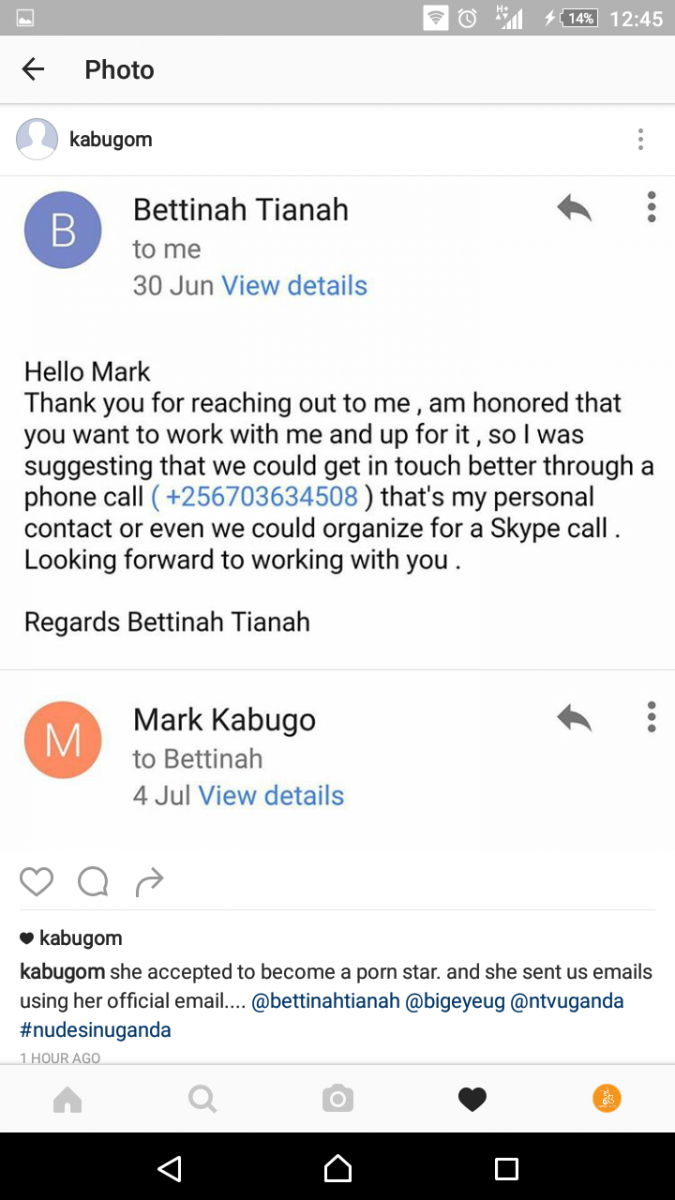
NB: THIS TARMAC ROAD WAS SWEPT BY RAIN YESTERDAY IN FRONT OF MY HOUSE AS I WAS WATCHING WITH MY OWN EYES!Bettinah Tianah’s Nud3 Pictures Leak; She was Paid Only $500 dollars

A one Kabugo has leaked exchanges in which he paid Bettinah Tianah 500 dollars in exchange for her nud3s. Thereafter, the two engaged in Skype s3x sealing their business. It seems after all, Bettinah’s true source of wealth has been revealed. She has one of those goats.
He will always be remembered. .He was here for 8 years but despite his little education he did more than what M7 has done in 30years. He had a reasonable cabinet. .a good parliament not one of thieves like today. .Where are the opposition mps while billions are given out to buy cars.. ?TULABYE BANANGE NAKASI KANO..
- AuthorPosts